The Water Is Gone. So Why Is Your House Still Wet?

The Water Is Gone. So Why Is Your House Still Wet?
One of the biggest misconceptions we see after water damage is pretty understandable.
The water is gone, so the problem must be over.
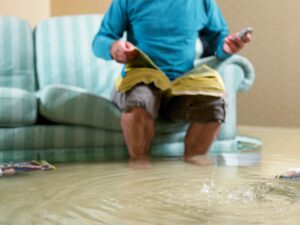
Maybe a washing machine overflowed. A pipe leaked. Rain found its way into the house during a storm. You cleaned up the standing water, ran some fans and everything looks dry again.
Problem solved, right?
Not necessarily.
Water has an annoying ability to go places homeowners can’t see.
And during Arizona’s monsoon season, when sudden storms and water intrusion become much more common, understanding that difference can save homeowners from discovering a much bigger problem weeks or months later.
Water Doesn’t Stay Where You Found It
Imagine spilling a glass of water on a countertop.
You can see exactly where the water goes.
Water damage inside a house doesn’t always work that way.
Water can move underneath flooring.
It can wick upward into drywall.
It can saturate insulation.
It can travel behind baseboards.
It can enter cabinets, wall cavities and other enclosed spaces.
Gravity pulls it downward while porous building materials can draw moisture outward and upward.
That means the wet spot you see isn’t necessarily the boundary of the problem.
Sometimes it’s simply the part you can see.
Dry to the Touch Doesn’t Mean Dry
Here’s another mistake that’s easy to make.
You touch the wall.
It feels dry.
You walk across the floor.
It feels dry.
Everything must be dry.
Unfortunately, the surface doesn’t always tell us what’s happening underneath.
Drywall, wood, insulation, carpet padding and other building materials can retain moisture even when the exposed surface appears normal.
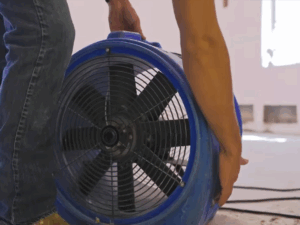
That’s one reason professional restoration involves more than pointing a household fan at the affected area.
Restoration professionals use moisture-detection equipment to determine where water has traveled and whether affected materials have actually reached appropriate moisture levels.
You can’t always determine that with your hand.
What’s Happening Behind the Drywall?
This is where water damage gets interesting—and potentially expensive.
Your walls aren’t solid.
Behind the drywall you’ll typically find framing, insulation, electrical components and open cavities.
If water enters that space, evaporation becomes much more difficult.
There isn’t much airflow.
Sunlight isn’t reaching it.
And you can’t see what’s happening.
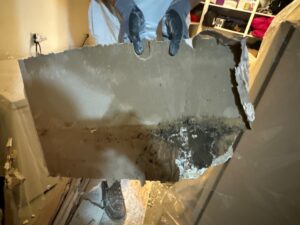
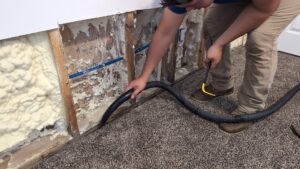
In some situations, sections of drywall or other materials may need to be removed so affected areas can be accessed and properly dried.
It can look dramatic when you see a restoration crew opening a wall.
But there’s a reason we’re doing it.
We’re trying to solve the problem you can’t see.
Arizona Monsoons Create Their Own Challenges
We spend much of the year thinking about Arizona as an extremely dry place.
Then monsoon season arrives.
Suddenly we’re dealing with intense rainfall, wind-driven rain, roof leaks, drainage problems, flash flooding and water finding weaknesses around windows, doors and other openings.
One storm can expose a problem that wasn’t obvious during the previous nine months of dry weather.
And because the storm passes quickly, homeowners sometimes assume the problem disappeared with it.
The sun comes back.
The ground dries.
The visible water gets cleaned up.
Meanwhile, moisture may still be sitting inside the structure.
Then Comes the Mold Question
This is usually where homeowners start getting nervous.
“Does water damage mean I’m going to have mold?”
Not automatically.
But moisture is one of the ingredients mold needs to grow, which is why properly addressing water intrusion matters.
The goal shouldn’t be to panic every time something gets wet.
The goal is to respond appropriately.
Find out where the water came from.
Stop the source.
Determine how far the moisture traveled.
Remove materials that cannot be appropriately restored when necessary.
Dry what can be saved.
Verify that the affected areas are actually dry.
Those steps matter much more than simply making the room look normal again.
Your Nose May Notice the Problem Before Your Eyes Do
Sometimes hidden moisture doesn’t announce itself with a giant stain on the wall.
Instead, homeowners begin noticing smaller changes.
A musty smell.
Baseboards starting to swell.
Paint bubbling or peeling.
Flooring beginning to warp.
A stain that seems to be growing.
Drywall that feels soft.
Those aren’t things we’d recommend ignoring.
Your house is pretty good at telling you when something has changed.
You just have to pay attention.
The First 24 Hours Matter
When significant water damage happens, speed matters.
The longer moisture remains inside building materials, the more opportunity there is for additional damage.
That’s why one of the best things a homeowner can do is respond quickly.
If it’s safe, stop the source of the water.
Protect belongings from additional damage.
Document what happened.
And when the situation is beyond something you can confidently handle yourself, call a restoration professional.
You don’t need to know what’s happening behind the wall.
That’s our job.
Restoration Isn’t About Making It Look Dry
This is probably the biggest takeaway.
After water damage, the goal isn’t to make your home look dry.
It’s to make sure your home is dry.
Those are two very different things.
At Legacy Restoration, we deal with the parts homeowners can see and the ones they can’t.
We locate moisture, determine what’s been affected, remove damaged materials when necessary, dry the structure and help homeowners work toward getting their property back to normal.
Because the puddle on the floor isn’t always the real problem.
Sometimes the real problem is where that water went next.
If your home or business experiences water damage, Legacy Restoration offers 24/7 emergency response.
Call 928-224-9115.